Gas detection3
Respiratory protection4
Technical rescue9
Firefighting4
Safety & environment4
Personal protective equipment2
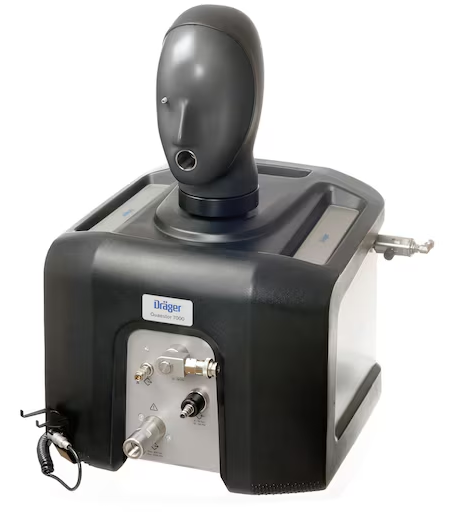
Dräger Quaestor 7000 — automatic respiratory-protection test station
The Dräger Quaestor 7000 is a fully automatic, computer-controlled test station for respiratory-protection (ODO) workshops. The test valves open and close automatically, and an external microphone itself detects the moment the low-pressure warning signal activates — the technician does not have to stand by the device throughout the test. Depending on the test-head variant, the unit tests full-face masks, gas-tight suits, hose-line breathing apparatus and self-contained breathing apparatus (optionally also closed-circuit breathing apparatus / CCBA and SCUBA diving apparatus) in accordance with EN 137 and the vfdb 0840-02 guideline.
Key features
- Fully automatic static and dynamic tests — the valves open and close automatically, with no manual intervention by the technician.
- An external microphone is standard and automatically detects the moment the low-pressure warning signal activates.
- 4 device variants for testing: full-face masks, gas-tight suits (CSA), hose-line breathing apparatus and self-contained breathing apparatus — optionally also closed-circuit breathing apparatus (CCBA), diving apparatus (SCUBA) and safety valves.
- High-precision measurements, independent of the manufacturer of the tested equipment, compliant with EN 137 and the vfdb 0840-02 guideline.
- Ergonomic, flexible pressure connections — extendable medium-pressure hose, rotating medium-pressure outlet.
- Gel "face" on the test head emulating the elasticity of human skin — fits all common mask sizes.
- Drägerware.workshop software with an equipment database, a report after every test and a schedule of upcoming test dates.
- Included: external microphone and holder for the pressure gauge/Dräger Bodyguard; optionally a QSI box (low-pressure signal muting), a mask-to-helmet adapter, and a stand for the breathing apparatus.
Technical specifications
| Parameter | Value |
|---|---|
| Type | computer-controlled, fully automatic test station for respiratory-protection equipment (ODO workshop) |
| Equipment tested (depending on variant) | full-face masks, gas-tight suits (CSA), hose-line apparatus, self-contained breathing apparatus (SCBA); optionally closed-circuit breathing apparatus (CCBA), diving apparatus (SCUBA), safety valves |
| Device variants | Standard / CCBA / SCUBA / SCUBA-CCBA / Complete (with regulator safety-valve test) |
| Measurement standards | EN 137, vfdb 0840-02 guideline |
| Dimensions with test head (D × W × H) | 50 × 55 × 65 cm |
| Weight (fully equipped, with test head) | approx. 25 kg |
| Storage temperature | -30°C to 60°C |
| Operating temperature | 0°C to 40°C |
| Permissible atmospheric pressure | 800–1200 hPa |
| Permissible humidity | 30–90% RH |
| Compressed-air supply | buffer cylinder or 300-bar pipework (stainless-steel pipe) |
| Pressure-sensor accuracy | class ≤1.0 per DIN EN 837 |
| High-pressure range | 0–350 bar |
| Medium-pressure range | 0–25 bar |
| Low-pressure range | -40…+30 mbar (-70…+30 mbar in the SCUBA variant) |
| O2 flow (CCBA) | 1–4 l/min |
| External connections | 1× USB to PC, 1× 24 V power supply (110/230 V), 1× external microphone connector |
| Artificial lung — breathing rate | 1–40 cycles/min |
| Artificial lung — max. breathing flow | 136 l/min |
| Artificial lung — max. tidal volume | 3.4 l |
| Software | Drägerware.workshop 5000/7000 — equipment database, test reports, inspection schedule |
| Manufacturer | Dräger |
Applications
Respiratory-protection service stations, fire brigades (state and volunteer) and chemical/hazmat industrial plants maintaining their own respiratory-protection equipment — periodic testing of full-face masks, gas-tight suits, hose-line apparatus and self-contained breathing apparatus, in line with manufacturer requirements and EN 137.
Frequently asked questions (FAQ)
What types of respiratory-protection equipment does the Quaestor 7000 test?
Depending on the device variant: full-face masks, gas-tight suits (CSA), hose-line apparatus and self-contained breathing apparatus (SCBA) as standard; optionally also closed-circuit breathing apparatus (CCBA) and diving apparatus (SCUBA).
Is the Quaestor 7000 still available as a new device?
The manufacturer has replaced this model with a newer generation — the Dräger Quaestor 8000. SafeTech selects the currently available test station (including the Quaestor 8000) to suit the needs of the respiratory-protection workshop, and provides service and support for Quaestor 7000 stations already in use.
Does testing require the technician to be present at the device the whole time?
No — the test runs fully automatically (the valves open and close by themselves, and the microphone detects the low-pressure alarm signal), so the technician can carry out other service tasks in the meantime.
Which standards do the measurements comply with?
Measurements are carried out in accordance with EN 137 and the German vfdb 0840-02 guideline, regardless of the manufacturer of the tested equipment.
Brand & service
The equipment and implementation are in the SafeTech range — selection of the test station for the respiratory-protection workshop (including the current-generation Dräger Quaestor 8000), delivery, commissioning, integration with Drägerware.workshop software, and service.
Why SafeTech
- 23 years of experience equipping fire services and industry (the company has operated since 2003).
- In-house respiratory-protection service station: cleaning, drying, testing and maintenance of breathing apparatus and masks.
- Selection of the test-station variant and configuration to match the scope of equipment used by the unit.
- Service, inspections and technical support in Suchy Dwór near Gdynia — service across Poland.
Availability & service — Gdynia and Tricity
Dräger Quaestor 7000 — automatic respiratory-protection test station — selection, delivery and service in Gdynia (Suchy Dwór, on the border of Gdynia and the Kosakowo municipality). We serve the Tricity (Gdańsk, Sopot, Gdynia), Rumia, Reda, Wejherowo, the Pomerania region and all of Poland. Ask about pricing and availability.